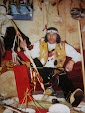
To better understand the Dignity of the First People of this Land......
It is almost impossible as Aboriginal people to go back to do exactly what our ancestors used to do, because living in our society today, we just can not give up what we have now. We have been absorbed by this society.
But what we can do is embrace a large proportion of our philosophy, our culture, and our way of doing things.
Thus restored, we will be able to incorporate into our lives a part of our core value system , for ourselves and our children , from the past, to the present, and into the the endless tomorrow.
Nina Sa'ke,j an James/VJM.
(Spirit of the White Wolf)
About Me
Saturday, 15 June 2013

Friday, 14 June 2013
THE SACRED PIPE AND THE SEVEN SACRED RITES
"Sacred Pipe and the Seven Sacred Rites"
The sacred Pipe Ceremony is one of communing with the forces of all life, all of which are symbolically placed in the tobacco The fire of transforms this from the creator with one's breath.
#1 Sweat lodge
#2 Crying for a Vision
#3 The Sun Dance
#4 The White Buffalo
#5 Adoption
#6 Keeping of the Soul
#7 Throwing of the Drum (Ball)
#1 Purification Ceremony.
#2 Vision Quest.....It is a period of meditation, with fasting.
#3 To give thanks to Father Sun for all he has provided Mother Earth.
#4 A puberty ceremony for young woman.
#5 To Adopt more Children, more parents, more brother's, more sisters... (Extended Family).
#6 For our young who die and did not have time to grow and expand the nature in this life.
#7 The Ball.....There are four directions, the centre is red, 2 blue strips painting on the cross each other, at right angles.
And beat the drum in four directions......
Which means to return from the spirit world.

(Sa'qewei- wjijaqamijl wipe's paqt-sm ) Ancient Spirit of the White Wolf.
Pikto'l Sa'ke'j Muise…VJM.
The sacred Pipe Ceremony is one of communing with the forces of all life, all of which are symbolically placed in the tobacco The fire of transforms this from the creator with one's breath.
#1 Sweat lodge
#2 Crying for a Vision
#3 The Sun Dance
#4 The White Buffalo
#5 Adoption
#6 Keeping of the Soul
#7 Throwing of the Drum (Ball)
#1 Purification Ceremony.
#2 Vision Quest.....It is a period of meditation, with fasting.
#3 To give thanks to Father Sun for all he has provided Mother Earth.
#4 A puberty ceremony for young woman.
#5 To Adopt more Children, more parents, more brother's, more sisters... (Extended Family).
#6 For our young who die and did not have time to grow and expand the nature in this life.
#7 The Ball.....There are four directions, the centre is red, 2 blue strips painting on the cross each other, at right angles.
And beat the drum in four directions......
Which means to return from the spirit world.
(Sa'qewei- wjijaqamijl wipe's paqt-sm ) Ancient Spirit of the White Wolf.
Pikto'l Sa'ke'j Muise…VJM.
Tuesday, 11 June 2013
TO THE EAST
Kwe!!
To the EAST.... It's the beginning to open hearts, lift up energy, think of the moment. We were blessed to be part of the creation, then the doors in all directions open and our grandfathers enter into our sacred ceremonies. The fire has the spirit of eternal life. Usually a pipe at the rising of the sun is mantled together. The female and male of the pipe tell us birth is a beginning but no end, just as the closing of the ceremonies could go on for seven day's or four, before the pipe is dismantled.
To the EAST ....The pipe may be passed around for people to smudge themselves . Before this all takes place the two fire keepers and the pipe carrier have many things to prepare .Women have to light the sweetgrass. Medicines has to be put in a smudge bole,
TO the EAST... Each place has it own way but are similar in nature. Drumming and chanting may be one ancient ceremony we do in respect for our grandfather's spirit as all around us some may want to dance, some ELDER's may do a teaching,
To the EAST many sacred objects will be there to see , and each object will have it's own story or teaching.. And if you pray this way the four winds and the first seven stages in life, you will be purified in body, mind and spirit..
BUT their is NO END.
Pikto'l Sa'Ke'j Muise/(Ancient Spirit of the White Wolf).
Sunday, 9 June 2013
HEALING
Maqmikawe'sku- Mother Earth Healing
My sisters and brothers across Turtle Island, hear me through a sacred breath of the Creator. generations of healing's that I am about to speak.
Our language and Customs of our people have not been forgotten.
The path that leads from your mother's umbillica cord , like stories of ancient times and our healings, customs and language, now are even older.
Healing, like language, comes from energy such as sound of our land, the wind, s and the waterfalls.
This has be projected from the Earth through our song and has a distinct openness that has not been found only through the blood of our ancestors.
To heal mentally, physically, spiritually one must encounter the experience of living off the land, Mother Earth and go through the different paths in life.
But, sometimes through stories and sacred ceremonies the plants , animals, forest and streams must be all our relations.
To the biggest end of our journey , we have to tone down our emissions (transform) and send our thoughts into a meadow of natural smells, sound ,sight, touch ,and speak the sacred words of our ancestors, Msitno'kmaq- All my Relations
Sa'qewei-wjijaqamijl waqe'k paqt-sm
Ancient Spirit of the White Wolf
Pikto'l Sa'ke'j Muise.
CHEWING GUM
CHEWING GUM
Aboriginal people discovered the first chewing gum, which was collected from spruce trees.
In the 1800s, sugar was added, and chewing gum has since become popular throughout the world.
SOURCE: First Nations and Inuit Contributions and Inventions Colouring Book
Aboriginal people discovered the first chewing gum, which was collected from spruce trees.
In the 1800s, sugar was added, and chewing gum has since become popular throughout the world.
SOURCE: First Nations and Inuit Contributions and Inventions Colouring Book
THE TOBOGGAN
The Mi’kmaqpeople of Eastern Canada invented the toboggan, or taba’gan, to use the Mi’kmaq word.
Toboggans were first made of bark and animal skins.
By the year toboggans were made of thin boards, curved at the front.
They were ideal for hauling game out of the woods, moving camp, and for travel.
Many winter sports have grown out of this original invention, including luge and bobsledding.
SOURCE: First Nations and Inuit Contributions and Inventions Colouring Book
Subscribe to:
Posts (Atom)